

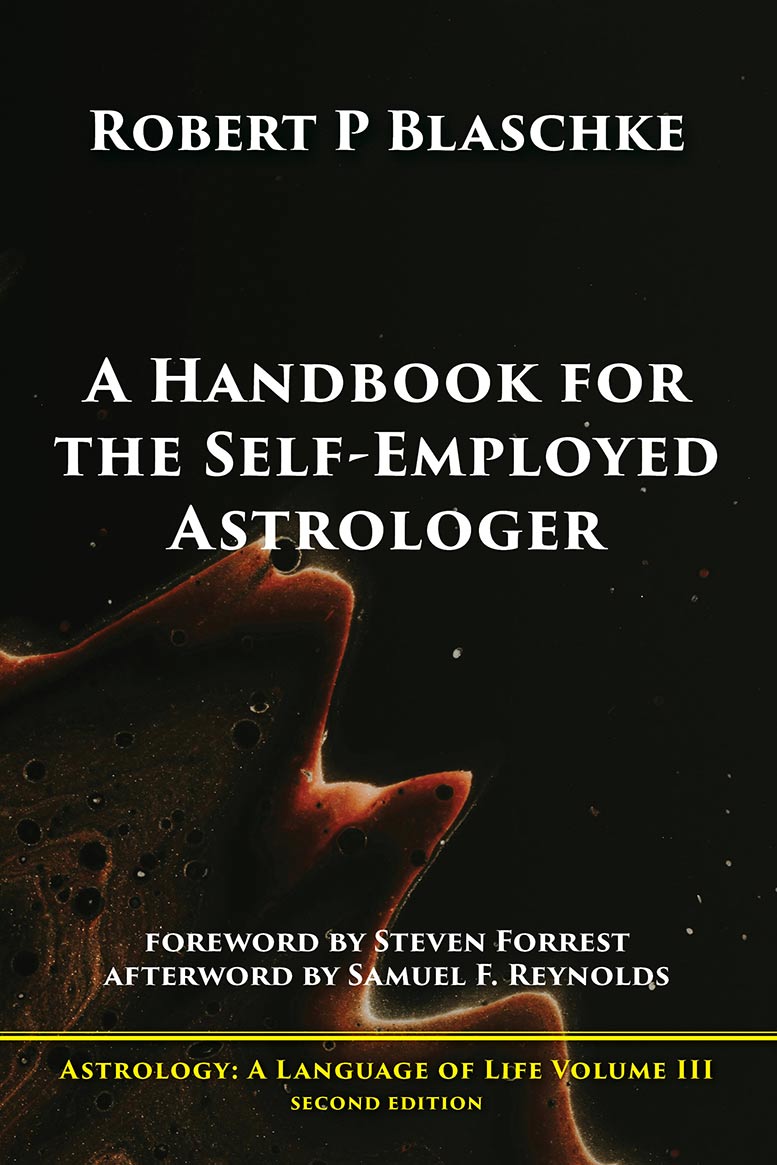
A Handbook for the Self-Employed Astrologer
$ 14.40
Foreword by Steven ForrestAfterword by Samuel F. ReynoldsContents Foreword to the First Edition (2002) by Steven Forrest “Well, Steve, what do you do for a living?” “I’m a professional astrologer.” Later that evening… “Steve, I know you’re interested in astrology, but what do you actually do for a living?” I’ve been through that conversation a few dozen times over the past twenty years. People just don’t believe you can actually make money as an astrologer. In the popular mind, astrology is a hobby, not a profession. They’re wrong! You can prosper reading astrological charts—and it is a profoundly rewarding career in all the ways that count: the work is meaningful, independent, and dignified. It is comfortably remunerative by the standards of most white collar professions. And it is at least slightly cool to boot! In his third volume of Astrology: A Language of Life, which he has subtitled A Handbook for the Self-Employed Astrologer, Robert Blaschke charts the course for anyone considering making astrology his or her life work. And he’s not just blowing smoke: he’s followed that course himself, and wound up prosperous, happy, and respected in his field. Like most of us, he’s had defeats as well as victories. He’s learned some lessons the hard way. And in the pages that follow he is blessedly forthcoming about everything, from soup to nuts. We astrologers have created a vibrant renaissance over the past fifty years. We’ve allowed ourselves to learn from modern psychology, absorbing much of it into our language and practice. We’ve been thinking deep thoughts about the place of human consciousness in the larger universe. We’ve ridden the breaking wave of computer technology, and are now armed with a powerful battery of new tools and techniques. We’ve founded schools, and even opened the soon-to-be-accredited Kepler College of Astrological Arts and Sciences in Seattle. We’ve held serious conferences with authentic intellectual exchanges and scholarly crossfertilization. We’ve become an international community, breaking out of at least some of the insularity of national borders. We’ve weathered legal challenges and learned how to defend ourselves against anti-astrology witch hunts. We’ve written a vast library, established serious journals, and compounded data bases for research. As a group, we astrologers are strong, numerous, merrily contentious, and deeply engaged in a profoundly creative process. Even though astrology is still often treated derisively in the media, our renaissance is spreading through the zeitgeist. Tellingly, a 1982 USA TODAY poll said 17% of Americans “believe in astrology.” In 1998, the number was up to 37%. That’s a more-than-doubled acceptance rate in those twenty-one years—and, from a business perspective, let’s add that those numbers represent of lot of potential customers! I attribute much of the increasing public acceptance of our work to the ongoing efforts of professional astrologers such as Robert Blaschke. They’re the ones fighting the trench warfare, winning the hearts and minds of open-minded people one at a time. They have been chipping away at the walls of resistance in the only way that really matters—by supporting real human beings with helpful, accurate astrological perspectives day after day. And those clients have been spreading the word, talking about their positive experiences. In my own practice I’ve sat with countless people who were “pressured by friends or mates” to see me. Most of them radiated skepticism and doubt upon arriving—and many of them have been back year after year ever since. To me, the battle to restore astrology to its natural place as one of humankind’s most precious allies is being won that way, hour by hour and person by person, out there in the real world, by professional astrologers simply doing their work. There are still too few of us. The field is wide open. The astrological community has been good at education and publishing, but we have been a catastrophe in terms of the practical work of actually helping people give up their “day jobs” and make the switch to full-time astrological work. We’ve been worse than a catastrophe at getting young people to recognize that astrology is a viable and attractive professional choice. Robert goes straight to the heart of these issues in his practical, Virgo Rising way. I particularly appreciate his Scorpionic willingness to overcome the social taboo about discussing money. That’s exactly the kind of practical information that needs to be disseminated if younger folks seeking professional training for their future careers are going to consider the field. We’ve got to help them break out of this pervasive “astrology-is-a-hobby” mindset. We’ve got to make the choice “real” in their minds—and money is of course a big part of human reality. Reading the pages that follow, you’ll learn in a step-by-step, nuts and bolts way how to establish and build an astrological practice. Meanwhile, subliminally, you’ll get the clear message: I can do this. That’s a big reason why this book is so precious, and why I am so grateful to Robert for taking the time to share what he has learned. One last comment. Occasionally, I’ve had unworthy thoughts about keeping the good news about astrology as a profession under my hat—sort of like not telling anyone about the undiscovered vacation spot you’ve found. Sometimes I can’t believe I actually get paid to do something I love so much. I travel to interesting places, yet I can work at home—no commuting! I’ve got money in my pocket. My wife and I own a nice house. I don’t hate Mondays, at least once the coffee kicks in. I’ve had a lot of opportunities to hang out with glamorous and influential people. I can dress and look as I please. Getting older only seems to help—no fear about being put out to pasture or “downsized.” And, most importantly, I will die knowing that I’ve made a real difference in people’s lives. But whenever I think of keeping the treasure map secret, I just laugh at myself. The potential market for serious astrology is so vast, and the ratio of competent astrologers to potential clients is currently so incredibly lopsided—it feels like a chance to buy stock in Microsoft back in the days when Bill Gates needed to borrow twenty bucks ‘til next Tuesday. Why not share it? Welcome aboard—and, Robert, thanks again for providing this service to us all. Steven Forrest 31 January 2002 Chapel Hill, NC Afterword to the Second Edition (2024) by Samuel F. Reynolds I had the privilege of knowing Robert P. Blaschke. We met at the second Blast conference in Sedona, AZ, in 2008. I initially encountered him virtually on MySpace astrology forums. Like many younger/youngish astrologers then (and now), I champed at the bit to show off our chops. Sometimes, it was done through analyzing a celebrity’s chart or verbally jousting with other astrologers about the virtues (or lack thereof) of some technique or astrological principle. But what always impressed me about Robert was that he rarely got into senseless debates and would patiently answer any questions that newbies or seasoned astrologers alike had. I got Robert’s Language of Life series and read his books with much relish, including a first edition of this very book. I also have a tape recording of my reading with Robert, and I cherish many of his insights and thoughts. However, as Robert describes in this volume, I was indeed one of those fledgling astrologers who got a consultation to see how a seasoned pro does it. Yet, as Robert writes, he didn’t seem to mind. Perhaps he could see that I would benefit from the reading and his example. He was right. Robert walked the walk and talked pretty closely, as discussed in this book. He wasn’t just ready to help another astrologer; he was eager. When I approached him in 2008 to do a course on predictive astrology for my school, the defunct Astrology Career Institute, he said “Yes” without hesitation. I still sell the course on my website, even though I no longer have the Institute. I’m still touched by his willingness to help me. I wasn’t much of a known quantity at that time, but Robert didn’t care. He cared about astrology and astrologers. This is what shines through most in Robert’s Handbook. The reader may have noticed that Robert’s meticulous advice on how to do things is mostly outdated. For instance, I had a good chuckle when I read Robert’s descriptions of the upgrade of his computer in chapter two. He published this book before the advent of the smartphone and probably would be amazed to know that the phones today would run circles around his upgraded computer. But he gives plenty of technical advice that’s still quite apt, including buying a Laser printer over inkjets. After three different inkjet printers and scores of inkjet cartridges, I didn’t buy a laser printer until 2019. I should’ve followed his advice sooner. However, early on in my career, I followed much of his advice in getting the right equipment, like using an adapter from Radio Shack to hook up to my phone when I recorded sessions via audio cassette and CD. I still splurge on office furniture because you should buy solid furniture that will last. Fortunately, I never had to do as much snail mailing as Robert did, but I had some, and several of his tips were very helpful with sending parcels through USPS. Other aspects of a self-employed astrologer’s business management are still challenging for today’s self-employed astrologers. Some astrologers have offices, but fewer do. Looking at the entire disclosure of Robert’s income and expenses is still helpful. At least, mainly. When I read his book, a woman I dated at the time who had a cushy corporate job looked at Robert’s income for 2002 and laughed. “You’re gonna have to do better than that if we’re gonna stay together,” she scoffed. We didn’t date long for other reasons, but her scoffing at Robert didn’t help. Honestly, considering that I was only making about $10-15k a year as a part-time astrologer then, I thought his breakdown gave me something to aspire toward. Most practicing astrologers don’t have a business plan plotting out their expenses, costs, and income, including projected revenue, and it shows with so many fledgling astrologers these days who rely more on crowdsourcing their lives when hitting rough patches. That’s not a sustainable business model. We might have fewer overhead expenses now, like office rent, copies, and supplies, but there are other expenses. And I’m pretty sure Robert would agree that there are even expenses we should make today. For instance, I know astrologers use free versions of services like Zoom, so they must ask their clients to jump off the call after 45 minutes and hop back into the room. Why they don’t purchase a license for extended use is beyond me, especially since they don’t even have to pay the $7500 annually that Robert had to pay for phone/long distance and office rent. Also, many astrologers use online software for their practices. Although services like astro-seek.com, lunaastrology.com, and astro.com are top-tier in what they allow practitioners to do, there’s a cap on the number of charts you can store for free on two sites. But the big issue is what happens when you’re somewhere with spotty or no internet/Wi-Fi. Do you end up leaving money on the table that you could have if you purchased software? Similarly, websites crash or go down for maintenance. That’s not as big of a problem if you have software. Although Robert doesn’t discuss these issues in his book because they didn’t exist, I believe he would. He emphasizes throughout his book the need for the astrologer to be professional and prepared. He clarifies that to survive or even thrive as a self-employed astrologer, you must subscribe to the old chestnut, “you must spend money to make money.” Doing astrology on the cheap might primarily assure cheap living. There are, of course, points where I can’t entirely agree with Robert, from minor to more major. Robert was very much a 20th-century astrologer who believed very much in many ideas of that era, like Uranus being the planet of astrology (rather than Mercury as had been true for over 2000 years) and accidental dignities related to the astrological alphabet, like Mercury being accidentally dignified in the third house. These are very minor. Although Robert believed very much in being in community with astrologers, even as an officer in organizations, he shied away from a firm conviction about certification or a larger group of standards to be employed in astrological education. He believed more in peer review, mentorship, and professionalism expressed through hard work, sincerity, and clear ethics. However, Robert didn’t have to deal with a growing number of astrologers who achieve massive followings on social media and have little to no astrological education, especially those vetted by other astrologers. As someone with certifications from two different international astrological organizations, ISAR and NCGR, and former president of the college where Robert once taught, the International Academy of Astrology (formerly the Online College of Astrology), I believe in certification and education. Robert says that no one asked for his credentials in all his years as an astrologer, and I have no doubt that’s true. Nor am I advocating that some governing body accredit anyone who wishes to practice astrology. I know some colleagues promote this point of view. Many believe this is necessary for astrology to achieve a respectable place in the academic and business worlds. I’m more moderate here. It’s less critical to regulate certification for broader cultural and economic legitimacy and more essential to ensure and validate that a practitioner has a well-rounded astrological education. Most astrology “schools” and teachers usually function as isolated, “one-room schoolhouses” where one teacher teaches their brand and understanding of astrology. Certification and collaboratively agreed upon standards and competencies between astrological educators, like earning badges for specialties in astrology, would break the insularity and seamlessly broaden students’ and professionals’ ability to advance their education with multiple teachers. And what’s more, perhaps clients will recognize the difference between an astrologer well-educated in astrology and one who merely has enough charisma, spunk, gift for gab, and grit to make a name for themselves. But, ultimately, there’s more to agree with than to disabuse with this book, especially with its final four chapters. Robert figuratively goes deep into the weeds to discuss the challenges that many self-employed astrologers face, like the isolation, alienation, and loneliness that can happen from primarily working on your own. And, prophetically, Robert didn’t believe that the internet would be the cure-all for this. As he writes in chapter nine, “I, myself, have serious doubts about the medicinal benefits of the Internet and the so called cyber- community [italics Robert’s].” He says in chapter eight, “An absurd downside of this phenomenon, which we can baptize as Holy E-Grail, is that a real, live astrologer might be living down the block from you, with whom you may never speak, while you are writing to a faceless soul in Finland or Japan.” Yet, as much as Robert encouraged communion between astrologers, he had a lot to say to astrologers as they set off toward sustainable and perhaps long-term self-employment. In his first chapter, he encourages self-confidence as the most essential factor for making that transition. He writes, “Your spiritual protection as an astrologer lies in the intention in your heart. If you set this intention as your sincere desire to help others, you can never go wrong. Besides, this power of loving service, along with adequate expertise, will fill you with confidence to do the work…Self-confidence, in my view, comes from loving others.” Methods and specifics might change, but in my own 30 years of experience, Robert correctly assures us that if we walk along the heavenly path as a terrestrial messenger for the stars with love, we’ll find our way and help others do the same. This is what makes this book timeless for every aspiring self- employed astrologer. With stellar affection, Samuel F. Reynolds, ISAR CAP, NCGR-III October 30, 2024 Acknowledgments Foreword to the First Edition by Steven Forrest Introduction Chapter One: Making the Transition from Student to Professional Astrological Education Organizational Certification Mentorship & Apprenticeship Testing Your Knowledge Level Visiting Another Astrologer to Observe Their Professionalism Techniques Required to Start Practicing Self-Confidence Doing Mini-Readings at Psychic Fairs Being an In-House Astrologer at a Local Bookstore Chapter Two: Establishing Your Professional Practice Leasing Commercial Office Space Part or Full-Time Aspirations Your Mission Statement & Setting of Intention Electing a Chart for the Start of Your Practice Office Furniture Computer & Printer Astrology Software Word Processing & Data Base Software Business Telephone Line, Voice Mail & Long Distance Service Acquiring a Toll-Free Number for Your Clients Internet Access Account & E-Mail Office & Postal Supplies Company Name & Logo Brochures & Letterhead Stationery Business Cards Sole-Proprietorship Business License Liability Insurance Post Office Box & Bulk-Mail Permit Astrological Mail-Order Business for Charts & Reports Becoming an Astrological Software Dealer Chapter Three: Handling Income, Expenses & Taxes Categories of Astrological Income & Expenses Creating Spreadsheets to Organize Your Practice Financially Paying Estimated Quarterly Taxes Using the Services of a Licensed Tax Consultant Resale License and Sales Tax Business Checking Account & Debit Card Invoicing Clients, Past-Due Notices & Late Charges Merchant Services Account Making Business Income Bank Deposits Paying Yourself as a Sole Proprietor Cash Flow, Business Loans & Carrying Debt Chapter Four: Marketing & Advertising Family, Friends & Co-workers Referrals Establishing an Advertising Budget Yellow Page Ads Alternative Practitioner Directories Display & Classified Ads Circulating Brochures & Business Cards Flyers & Bulletin Boards Newsletters & Client Birthday Mailings E-Mail Mass Mailings Building a Website Media Appearances Chapter Five: Navigating the Client Relationship Scheduling Appointments Preparing for the Client Appointment In-Person, Telephone & By-Mail Consultation Requisite Equipment for Recording Consultations Fee Structure, Sliding Scales & Fee Increases Payment of Consultation Fees Your Professional Consultation Environment Attire & Appearance Communication Skills The Decision-Making Process of the Client Ethical Considerations Working With an Attitude of Love & Service Progressed Synastry with the Client The Consultation Appointment Chart Consulting to Other Astrologers Being a Spokesperson for the Planets Chapter Six: Teaching Astrology & Public Speaking How Teaching Contributes Income to Your Practice Where are the Teaching Opportunities? Starting a School of Astrology Teaching at Bookstores, Colleges & Metaphysical Centers Designing a Beginning Class Syllabus Textbooks, Weekly Handouts & Homework Assignments Tuition Fees & Pre-Registration Incentives Designing an Intermediate Class Syllabus Saturday Workshops & Tuition Fees Selling Your Class & Workshop Tapes Local Public Speaking & Lecturing Chapter Seven: Writing, Publishing & Lecture Travel Astrological Journal & Magazine Articles Newspaper & Magazine Sun-Sign Columns Getting Paid to Write for Astrological Websites Research Papers Writing Your First Book How to Become a Self-Published Author International Standard Book Numbers Library of Congress Control Numbers Scannable Bar Codes Retail Prices Cover Art Back Cover Photo & Content Synopsis Forewords Designing Your Book Cover Printer Quotations Financing Plan & Direct Marketing to Astrologers Book Distributors Amazon.com Advantage Account Book Reviews Lecture Travel & Earning Astrological Income on the Road Chapter Eight: Participating in the Astrological Community Service & Membership in Local Astrological Associations Service & Membership in National Astrological Organizations Referrals & Professional Courtesy to Colleagues Salons, Internet E-Mail Groups & Message Boards Professional Ethics, Collusion & Other Considerations Chapter Nine: Overcoming Occupational Hazards The Self-Employed Experience Jupiter Cycle Financial Stress & Worry Academic, Scientific & Religious Community Condemnations Isolation, Alienation & Loneliness Patience, Faith & Perseverance The Impact on Your Personal Life Living With No Medical Insurance or Retirement Plan Consultation Burn-Out Teaching Burn-Out Sustaining Your Practice Through Personal Loss & Tragedy The Mythological Experiences of the Career Astrologer Chapter Ten: Fostering Personal & Spiritual Growth Walking the Talk Meditation, Prayer & Personal Renewal Exercise & Nutrition Partners, Friends & Family Hobbies Outside of Astrology Going Through the Inevitable Hard Times Chapter Eleven: Notes for Astrologers in the UK & Australia Astrology in the UK by Paul F. Newman Astrology in Australia by Scott Whitters Chapter Twelve: Epilogue The Joys & Rewards of Practicing & Teaching Astrology Solidarity: Why Self-Employed Astrologers Need One Another Remaining Loyal to Your Inner Light Afterward to the Second Edition by Samuel F. Reynolds Appendix: Sample Syllabus, Homework & Reading List Bibliography Robert P. Blaschke (1953–2011), in practice from 1979–2009 and founder the Earthwalk School of Astrology in 1992, continues to be an internationally respected professional astrologer, known for his consulting, lecturing, and teaching prowess. He lectured at regional and international astrology conferences in the US, Canada, Australia, South Africa, and Serbia. In 2012, Blaschke posthumously won a Regulus Award for Discovery, Innovation and Research. His critically acclaimed five-volume Astrology: A Language of Life series remains a definitive contribution to the astrological field and to the advancement of serious astrologers worldwide.