

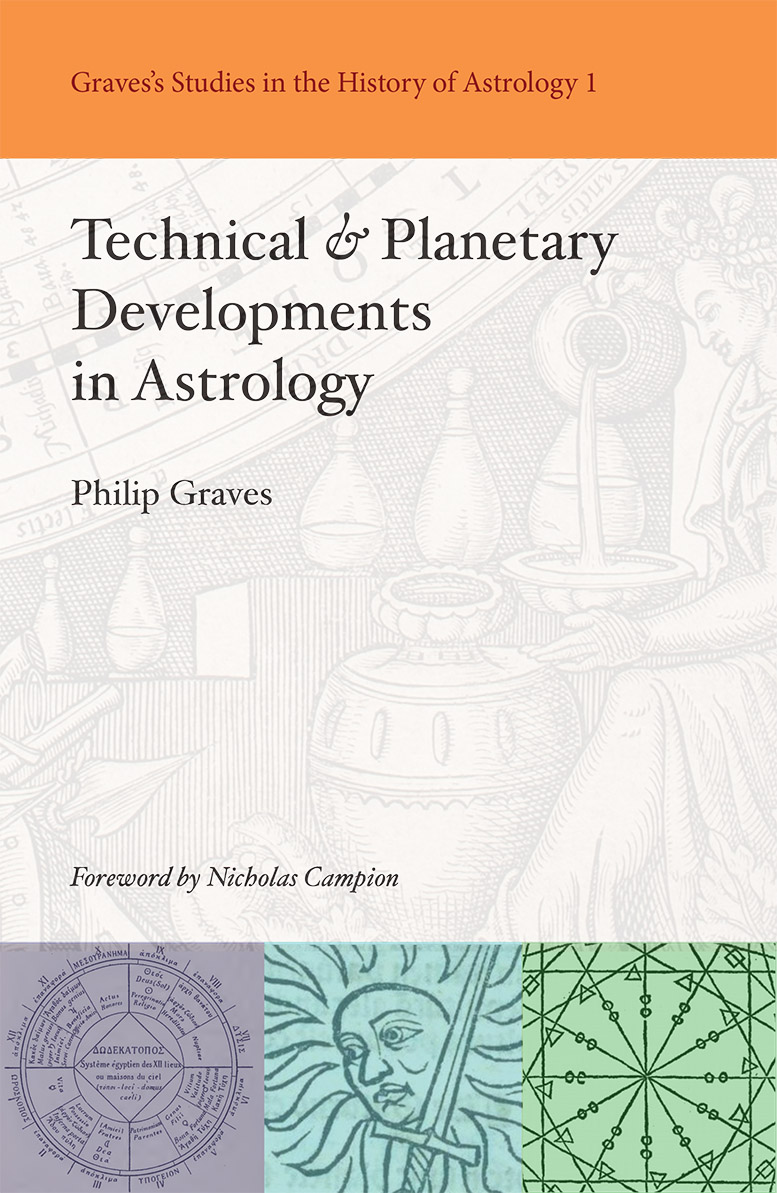
Technical & Planetary Developments in Astrology
$ 11.82
Foreword to Technical & Planetary Developments in Astrology by Philip Graves by Nicholas Campion Philip Graves’ meticulous and detailed examination of technical issues in the history of astrology marks an original contribution to our understanding of the development and nature of western astrology. Graves has taken eight specific areas of astrological interpretation, all of which are, in their different ways, fundamental to both the practice of astrology and its cultural position. Concerning the practice of astrology, Graves has documented the development of the meaning of the houses, planetary aspect theory from the seventeenth century onwards, and the textual history of the attribution of meaning and rulership to the three principal ‘outer planets’, Uranus, Neptune and Pluto, as well as discussions concerning the minor, and loosely-defined body, Lilith. As far as astrology’s cultural position and mass appeal is concerned, Graves has documented the development of the ascent of the Sun-sign to its central interpretative role, and the early appearance of the so-called Sun-sign column. He both has questioned the widespread argument that the theosophical astrologer Alan Leo was responsible for the importance attributed to the Sun-sign and overthrows what is now known to be the myth that R.H. Naylor originated the modern newspaper astrology column in 1930. Graves’ fascinating account of the development of the meaning of the astrological houses, aspects, and outer planet rulerships, provides insights into how they are both created and change over time. He therefore reinforces the perspective of those modern astrologers (such as Leo’s fellow, but later, Theosophist, Dane Rudhyar) for whom the meanings attributed to astrological symbols were culturally relative (even if they were still believed to provide insight into deeper spiritual truths). He also therefore challenges those astrologers for whom such astrological factors represent some kind of fixed objective truth in themselves. The boom, small though it is in relation to other areas, in the historiography of astrology over the last fifty years, has been almost entirely concerned with its ideas and intellectual constructs, or ‘mentalities’, and with social history. Only historians of Mesopotamian astrology have seriously considered technical matters. Graves has done us all a favour by opening a way to the study of the history of technical methods, and the basis on which astrologers’ interpretations are constructed, from the Hellenistic period onwards. He has provided future students of the history of astrology with a pathway which can no longer be ignored. Graves’ work is therefore entirely in line with the approaches we have developed in teaching the history of astrology in the MA in Cultural Astronomy and Astrology at the University of Wales Trinity Saint David, where we insist that students explore not just what astrologers say about what they do, but what they actually do. That is, astrologers may write one thing about what they think astrology is, but their delineations of sample horoscopes may tell another story. Graves does not look at individual chart delineations, but he examines the development of the fundamental claims which underpin those delineations. Graves’ book is vital documentary history. It should be essential reading both for those historians who wish to understand the development of technical astrology, and for those students of astrology who wish to be better informed about the foundations of their own practice. Nicholas Campion University of Wales Trinity Saint David February 27th 2025 Table of Contents Acknowledgments xii Foreword by Nicholas Campion xiii Introduction xv Part One: The Evolution of the Astrological Houses and Astrological Aspect Theory 1. From Manilius to Modernity: A Study of the Evolution of the Meanings of the Astrological Houses 3 Introduction 3 The Oktatropos or Oktatopos 5 i. Thrasyllus 5 ii. The Michigan Astrological Papyrus 6 iii. Antiochus of Athens 8 iv. Julius Firmicus Maternus 8 Lot-Houses 9 The Evolution of the Meanings of the 12 Houses 10 1. Marcus Manilius (fl. 1st century CE) 10 2. Thrasyllus (died 36 CE) 12 3. Dorotheus of Sidon (c. 75 CE) 14 4. Ptolemy (c. 100–178 CE) 15 5. Vettius Valens (c. 120–175 CE) 15 6. Antiochus of Athens, The Thesaurus (summary) 17 7. Michigan Astrological Papyrus (estd. 2nd century CE) 18 8. Porphyry (c. 232–304 CE) 19 9. Julius Firmicus Maternus (c. 20 – c. 360 ce – text ca. 335 CE) 20 10. Paulus Alexandrinus – (born 330 ce; written 378 CE) 20 11. Hephaestio of Thebes (born 380 ce; text written ca. 415 CE) 22 12. Rhetorius the Egyptian (ca. 505 CE) 22 13. Liber Hermetis 24 14. Masha’Allah (c. 740–815 CE) 24 15. Omar of Tiberias (died c. 815 CE) 25 16. Abu ‘Ali Al-Khayyat (c. 770–835 CE) 26 17. Sahl ibn Bishr (fl. 811–825 CE) 27 18. Abū Ma’Shar al-Balkhî (c. 787–886) 29 19. Al-Qabîsî (d. 967) 30 20. Al-Rijāl (Haly Abenragel) (d. ca. 1040) 31 21. Al-Bîrūnî (973 – ca. 1048) 35 22. Abraham Ibn Ezra (c. 1089–1164) 36 23. Guido Bonatti (ca. 1210–1295) 38 24. Leopold of Austria (compilation written c. 1271) 40 25. Johann Schöner (1477–1547) 41 26. Claude Dariot (1533–1594) 42 27. William Lilly (1602–1681) 44 28. Morin de Villefranche (1583–1656) 46 29. John Gadbury (1627–1704) 48 30. Alan Leo (1860–1917) 50 Conclusion 55 Endnotes 55 2. From Kepler to Addey:A Chronology of Developments in Astrological Aspect Theory from 1602 to 1976 63 Part One: Traditional Approaches to Astrological Aspects 63 i. Which aspects were traditionally recognised? 63 ii. How were aspect orbs traditionally calculated? 64 Part Two: The Aspect Innovations of Johannes Kepler 66 i. What changes did Kepler propose to the system of aspects? 66 ii. Reception of the harmonic aspects after Kepler, 1647–1913 68 a. William Lilly 68 b. James Wilson 68 c. Zadkiel 69 d. W. H. Chaney 70 e. Llewellyn George 71 Part Three: Astrologers’ Departure from Planetary Orbs, 1861–1900 72 i. Richard Morrison (1861) 72 ii. W. H. Chaney (1890) 73 iii. Alan Leo and Frederick Lacey (1890) 75 iv. Robert T. Cross (1891) 79 v. H. S. Green (1892) 80 vi. Alfred Pearce (1892) 81 vii. George Wilde and J. Dodson (1894) 82 viii. Alan Leo (1897) 82 ix. Sepharial (1898) 83 Part Four: 20th-Century Developments in Harmonic Aspect Theory 84 i. Noviles gaining acceptance? The aspect instruction of Karl Brandler-Pracht 85 ii. Septiles and Quarti-squares? The new aspect innovations of George Wilde 85 iii. Neutral 15° Aspects? The ideas of A. Frank Glahn 87 iv. Potent 15° Aspects? The Notions of K. W. von Elmensberg 88 v. The Numerological Circle Division Factor Theory of Charles E. O. Carter 89 vi. Consolidation of Harmonic Aspect Theory by Dr. Walter Koch 91 vii. Wider adoption of quartisextiles – the testimony of Thomas Ring 93 viii. Harmonic Theory Revisited: the Integrally Harmonic Astrological Philosophy of John Addey 95 Afterword: the Statistical Research of Karl-Ernst Krafft 98 Appendix: Addey’s System Moderated: The Graves Method of Orb Calculation 98 The Harmonics after Addey – A summary Bibliography, 1977 to 2019 102 Endnotes 104 Part Two: Astrologers’ modern treatments of the Sun, and integration of the outer planets and Lilith 3. The Rise of the Sun: the Natal Sun Emphasised, 1887–1959 113 Part 1: A Summary of Sun-sign Writings before 1887 113 Part 2: Butler’s Revolution: Solar Biology and the Soli-Lunar Polarities unleashed 117 Part 3: The Solar Revolution Reverberates: Increased Solar Prominence in General Astrological Writings, 1889 to 1952 123 Part 4: Solely the Sun: The Unstoppable Rise of the Sun-sign Primer, 1894 to 1959 124 Part 5: Law of the Lights: Works on the Sun- and Moon-sign Combinations after Butler 131 Part 6: The signs of the zodiac divided: The Draw of the Degrees, 1879–1953 132 Part 7: Lustre of the Luminaries through the Lens of Leo: Alan Leo’s teachings around the natal Sun and Moon, 1896–1913 135 Endnotes 145 4. The Early History of Sun-sign Forecasting and Newspaper Astrology, 1890–1937 Introduction: What is Sun-sign Forecasting and Why is it so Controversial? 152 Part 1: Precursors to Sun-sign Forecasting in the late-19th-C. Astrological Press 154 Part 2: Representation of astrology in United States Newspapers before 1910 155 Part 3: The first regular newspaper astrology columns 161 Part 4: Early Solar Degree Area Forecast Columns 164 Part 5: The first twelve-paragraph Sun-sign forecast columns 167 Part 6: The first Sun-sign forecasting in the UK press 171 Part 7: The true role of R. H. Naylor in the history of newspaper astrology 172 Conclusion 175 Endnotes 176 5. The Earliest Astrological Conceptualisations of the Planet Uranus, 1781–1839 When was Uranus first discovered? 181 How and when did Uranus come by its name? 182 How did astrologers react to the discovery of Uranus? 184 The Conjuror’s Magazine (1791–93) 185 Thomas White (1811) 187 P. J. Swift (1812) 187 The Monthly Correspondent on Physical and Prognostic Astronomy (1814) 188 James Wilson (1819) 192 The Straggling Astrologer 194 Uranus invoked as a contributory cause of major fires 195 Uranus as a cause of death by transit 197 On the question of the essential dignities of Uranus 197 The Spirit of Partridge (1824) 198 Robert Cross Smith (Raphael I) (1828) 200 Thomas Oxley (1830) 203 Rupertus Stella (1832) 203 Richard Morrison (1833) 204 The Horoscope (1834) 205 Uranus in the prediction of weather 206 Uranus in the prediction of Earthquakes 206 Uranus in Mundane Astrology 208 Debates over the influence and essential dignities of Uranus 208 Uranus in nativities and as a cause of critical illness and death 210 David Parkes (1839) 212 Conclusion 214 Endnotes 214 6. When Did Astrologers First Associate Neptune with Pisces? 223 Introduction: When and how was Neptune discovered? 223 Part One: Why did it take so long for astrologers to incorporate Uranus and Neptune into their practice? 224 Part Two: The first published sources on the question of Neptune’s sign rulership 227 1. Alfred Pearce (1880) 227 2. Friend of J. T. Campbell (1888) 228 3. John Ackroyd (1890) 228 4. Nemo (pseud.) (1892) 229 5. Thomas H. Burgoyne (1892) 230 6. “Sagittarius” (1894) 230 Conclusion 232 Endnotes 233 7. The First Published Assessments on the Sign Rulership of Pluto 235 The first published assessments on the sign rulership of Pluto, 1897–1931 235 1. Fomalhaut: Aries (1897) 235 2. Isabelle Pagan: Scorpio (1907; 1908; 1911) 236 3. A. E. Thierens: Aries (1911 / 1931) 238 4. A. M. Wrey: Scorpio (1913) 238 5. Sepharial: Aries or Scorpio (1918) 239 6. E. Caslant: indeterminate, probably Aries (undated, before 1926) 239 7. Francis Rolt-Wheeler: indeterminate (1930) 241 8. Elizabeth Aldrich: indeterminate (1930) 241 9. L. H. Weston: indeterminate (1930) 242 10. Llewellyn George: Scorpio (1930) 243 11. Frederick Thoresby: Scorpio (1930) 247 12. J. P. Gross: Leo (1930–31) 247 13. Bessie Leo; and ‘E. S.’: Scorpio (1931) 248 14. Karleen S. Lyon (presumed): Scorpio (tentative) (1931) 248 15. E. H. C. Pagan: Scorpio (1931) 249 16. C.E.O. Carter: indeterminate (connections with Cancer, Scorpio) (1931) 250 17. Mabel Baudot: Scorpio (1931) 252 Conclusion 253 Endnotes 254 8. Lilith in Astrology: Second Moon, Asteroid, or Lunar Apogee? 255 Part One: Lilith as a Second Moon of the Earth: Speculations, 1898–1918 255 Sepharial’s role in the naming of Dark Moon Lilith 256 From Two Moons to Three? 258 The Influence of Dark Moon Lilith: first judgements 259 The Dark Moon Wars: Sepharial clashes with Wilson 261 Three More Dark Moons? The mysteries deepen! 264 Fading Interest: Alan Leo Marginalises Lilith 268 Alfred Pearce on Lilith: Total Disinterest 269 Early French sources on Dark Moon Lilith (selection) 269 Later American Sources on Dark Moon Lilith (summary) 270 Part Two: Black Moon Lilith: first conceptualisations, 1935–1943 271 Later treatments of Black Moon Lilith: selected references 275 Part Three: Lilith as Asteroid – early research, 1980–2000 (summary) 276 Endnotes 277 Index 281 About the Author Philip Graves Philip Graves is an astrological researcher, historian, writer, and lecturer who founded and continues to develop an extensive multilingual astrological reference library. Graves formerly wrote a wide range of articles on the principles and techniques of astrology, and has since produced a substantial body of original essays on the history of modern astrology, appearing through Revelore Press in four volumes. The library, currently based in Newport, South Wales, UK, features over 8,000 unique edition-volumes of books and 12,000 issues of magazines, journals, and almanacs. You can support it via https://www.astrolearn.com/donate-sponsor-astrology-library/ or browse the full catalogue at www.astrolearn.com/astrology-bibliography